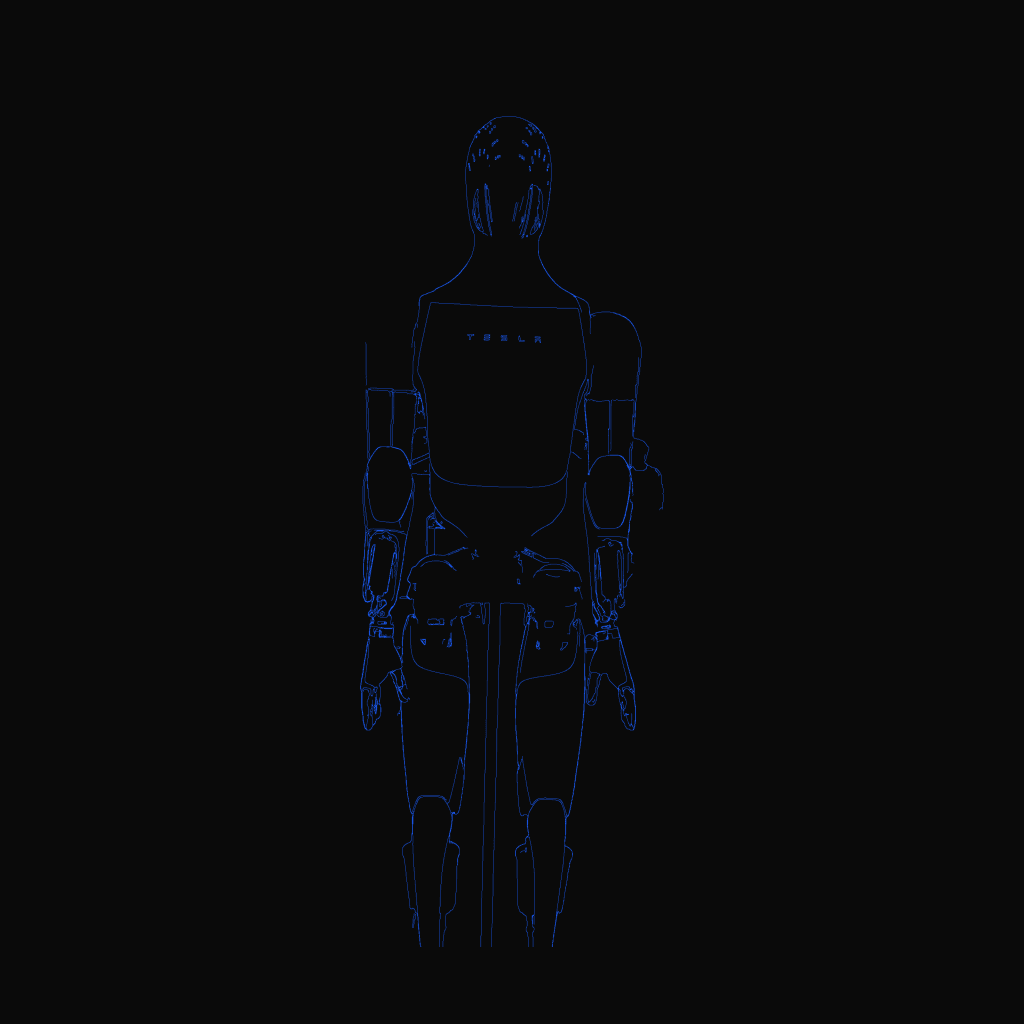
Tesla's bipedal humanoid program. Generation 2 was unveiled on Tesla's official channels in December 2023; the announcement was covered verbatim by Electrek and Not a Tesla App, both quoting Tesla's own video for actuator count, hand DoF, neck articulation, and the weight-reduction-plus-speed-boost line. Tesla's Q4 2025 update, published in January 2026, said Gen 3 would be unveiled in Q1 2026 as its first design meant for mass production.
What makes Optimus distinct for the AI-hardware reader is the stack lineage: it runs Tesla's FSD vision-only end-to-end neural networks rather than a hand-engineered control pipeline. No LiDAR, no depth sensors — just cameras, the same architectural bet Tesla made on cars. Gen 3 moves every finger actuator into the forearm and routes tendons through the wrist, mirroring human anatomy.
Caveats worth flagging: Tesla does not publish an official Optimus spec sheet. The figures here trace to Tesla's December 13, 2023 announcement video plus the Q4 2025 earnings call; we lean on trade-press coverage that quotes those primary materials verbatim because tesla.com actively blocks scraping. Battery and runtime numbers are repeated across industry coverage but Tesla has not confirmed them in a public release. Treat them as best-available, not Tesla-official.
Status, checked 2026-09-24: the Gen 3 reveal slipped. On Tesla's April 2026 earnings call Musk moved it to around mid-year, and trade press still reported it unrevealed on 2026-09-23. Tesla's Q1 2026 update said its first-generation Optimus line, designed for 1 million robots a year, would replace the Model S and Model X lines in Fremont. Its Q2 2026 update, published in July 2026, said those lines had been decommissioned and Optimus lines were being installed, with production expected later in 2026 and the first builds going to Tesla's internal Optimus Academy for training-data collection. The end-2027 public-sale target comes from Musk's remarks at Davos in January 2026, not from the earnings call.